Aviator
How we check, test and calculate
This page explains the method behind operator profiles, probability tables and simulations on this site. Operator information changes quickly, so we distinguish facts we can calculate from claims a reader must verify live.
The operator-profile method
Each operator in our comparison table is assessed against five practical checks. We no longer show numerical casino scores: a decimal can imply a level of certainty that changing offshore terms do not support.
| Check | What we look for | What it cannot prove |
|---|---|---|
| Company and licence | Legal entity, exact domain and a licence number verifiable with the named offshore regulator | That the service is licensed or legal in India |
| Aviator implementation | Spribe branding, RTP in the live help screen, both bet panels and provably-fair round data | That another domain or future build is identical |
| Payments and KYC | Written withdrawal windows, closed-loop rules, verification demands, fees and limits | That a specific payment will succeed or arrive quickly |
| Terms and promotions | Wagering rules visible before acceptance, game exclusions, win caps and “irregular play” clauses | That a headline bonus is good value |
| App provenance | Publisher, source domain, checksum, update path and requested permissions | That a sideloaded clone using the same name is safe |
Two things do not influence the order of profiles:
- Bonus size. A bigger bonus is a bigger wagering requirement, and bonus terms are the single most common cause of a blocked withdrawal. We treat clear terms as the positive signal, not headline numbers.
- Commission. How much an operator pays us has no input into the profile order. See our editorial policy for the funding disclosure in full.
What an operator profile cannot tell you
Since the Promotion and Regulation of Online Gaming Act, 2025 took effect, offshore real-money availability sits in a category the Act prohibits. A detailed profile does not make an operator safe, legal or regulated in India. The legal page is essential context before any third-party offer.
How we compute the probability tables
Every odds figure on this site comes from one model, stated openly so you can check it:
P(a round reaches multiplier x) = 0.97 ÷ x
This is the standard 97% RTP crash curve. It produces the ~3% of rounds that crash instantly at 1.00×, the 1.94× median, and the full distribution on our RTP page. Derived figures:
| Quantity | Formula |
|---|---|
| Chance of reaching target t | 0.97 ÷ t |
| Average wait between hits | 1 ÷ p |
| Dry streak that 95% of sessions stay under | ln(0.05) ÷ ln(1 − p) |
| Dry streak that 99% stay under | ln(0.01) ÷ ln(1 − p) |
| Expected return of any target | stake × 0.97 |
How we simulate strategies
The strategy results on our strategy page come from a Monte-Carlo simulation we wrote for this site:
- 200,000 independent sessions per betting system.
- Each session: ₹2,000 bankroll, ₹20 base stake, 2.00× cash-out target, up to 100 rounds, with the stake capped at the remaining balance.
- Crash points drawn as 0.97 ÷ U, where U is uniform on (0,1), floored at 1.00× — the standard model behind a 97% RTP crash game.
- Systems implemented as normally described: flat, Martingale (double on loss), D'Alembert (±1 unit), Fibonacci (up one step on a loss, back two on a win), Paroli (double on win, reset after three).
- Reported: median end balance, share of sessions ending in profit, share wiped out, average total staked, and drawdown percentiles.
The validation check that tells you the simulation is sound: flat staking puts ₹2,000 through the game in 100 rounds and finishes at a mean of ₹1,940 — exactly 97% of the amount staked. Any implementation that does not reproduce that is wrong.
We publish the ugly columns alongside the flattering ones on purpose. Martingale genuinely wins 61.1% of sessions; it also wipes out 33.2% of them. Both numbers come from the same run.
Our tools
The calculators and simulators on this site are built on the same maths and run entirely in your browser — nothing you type is sent anywhere.
- The practice simulator generates crash points with 0.97 ÷ U, so its long-run behaviour matches a real 97% table. It uses virtual credits only.
- The probability calculator returns 0.97 ÷ x for a target, plus the dry-streak figures derived from it.
- The win and risk calculators show the payout and what a normal losing streak does to the same bankroll, because a calculator that only shows the good half is marketing.
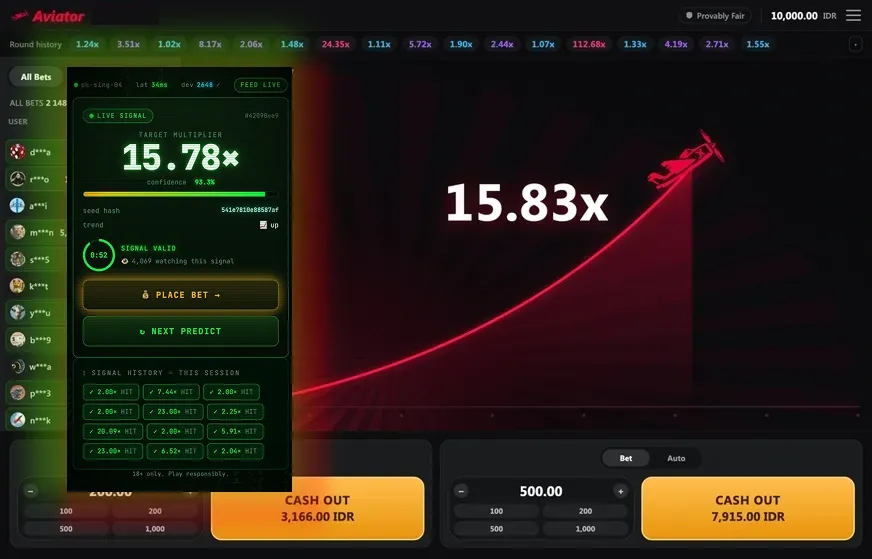
None of them predicts a round, and none ever will. That is not a limitation of our implementation, it is a property of a provably-fair game — explained here.
When we update
- Legal and tax pages: whenever the position changes. The Act's Rules took effect 1 May 2026 and the Supreme Court challenge is pending, so this is live.
- Operator profiles: when an operator's published terms, payment claims or Aviator implementation change materially.
- Maths and simulations: when we improve the model. The method above is versioned in the text, so a changed method is visible rather than silent.
Found an error? Tell us via the contact page — see the corrections section of our editorial policy for how we handle it.
Want to explore Aviator?
Start with the free simulator and probability tools. If you open a third-party offer, check local law, terms and payment risk first.